
Electronic Interlocking Systems (EI)
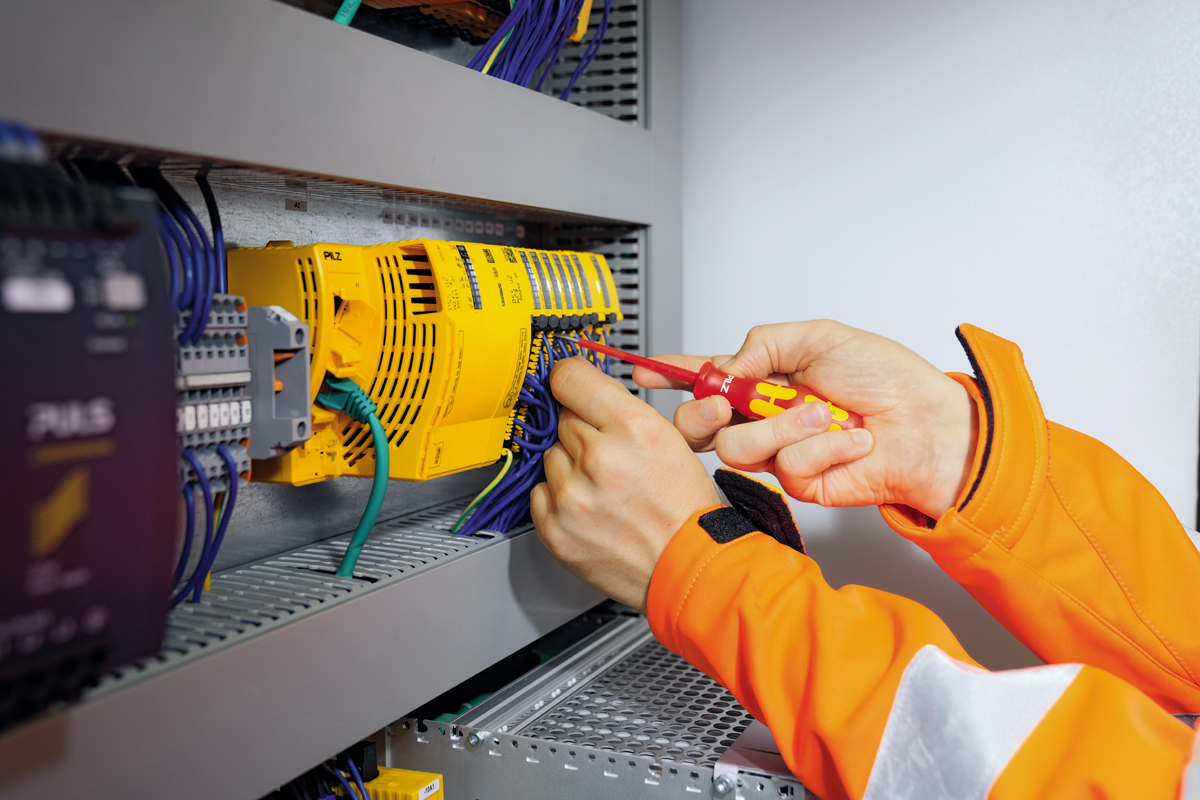
Electronic Interlocking (EI) using PILZ PSSrail as a safe, modular, scalable railway control system designed for high-integrity signalling applications. Certified up to SIL-4, it combines redundant architectures, rail-grade safety controllers and fail-safe hardware and software.
Local or Decentralized. Built to Scale.
The system supports both local and decentralized architectures, making it suitable for small conventional interlocking installations and geographically distributed field locations. Its redundant backplane, independent power supply groups and galvanic isolation enhance system availability and reduce the risk of common-mode failures.
Open, Flexible & Future-Ready
With support for EULYNX, modern engineering tools and freely configurable I/O, PILZ enables flexible system design while reducing dependence on proprietary architectures. Diagnostic capabilities, remote service and scalable hardware help simplify engineering, commissioning and maintenance while supporting future railway signalling requirements

MSDAC ( Multi Section Digital Axle Counter )
BO23 series (BO23) axle counters are well established and recognized axle counters from ALTPRO. The axle counters are SIL4 certified and conform to all relevant norms according to CENELEC. BO23 is usually used in pair with wheel sensor ZK24-2 and they form a robust and reliable combination which is in use in more than 25 countries worldwide. It can be used in various applications on main lines, secondary lines, tram and LRT lines.
Outdoor Equipment
Our trackside equipment consists of wheel sensors and the corresponding trackside components. We offer different variants of axle counters, with varying amounts of trackside equipment, tailored to the application and customer requirements. Outdoor equipment is housed in IP-certified enclosures to ensure optimal protection and long service life.

Functionality
BO23 uses wheel detection technology. One indoor unit controls up to 8 counting points configured up to 6 sections (selection of 9 predefined configurations) . The system proved its performance in railway, tram and metro applications. Axle counting can be performed at train speeds up to 350 km/h.
Safety
The system is developed and certified according to standards EN 50126, EN 50128 and EN 50129 for the highest safety integrity level SIL4, as well as EN 50125-3 for hars environmental conditions and EN 50121-4 for EMC. BO23 is assessed and certified by TÜV Rheinland.
FSDT
FSDT is used for fail-safe digital signal acquisition, evaluation and transmission of data through any media for digital data transfer, using third-party devices as bridge to the desired communication channel.
Functionality (Benefit)
The main purpose of FSDT devices is to safely transfer a certain amount of single-bit data from one location of railway signalling equipment to another such location, in both directions. 6/12 parallel digital inputs are constantly scanned in a safe manner, multiplexed and transmitted to an adjacent FSDT device and converted into parallel data bits for the adjacent FSDT outputs.
Safety
The device is developed and certified according to standards EN 50126, EN 50128 and EN 50129 for the highest safety integrity level SIL4, as well as EN 50125-3 for environmental conditions and EN 50121-4 for EMC. FSDT12 is assessed and certified by Certifer Italia SrIU. It is designed for use in a closed transmission system according to EN 50159, Category 2.


Maintenance
There is no need for complex maintenance activities. Device maintenance includes a periodical review of the installed equipment. Reviews include a simple and fast check of proper function of FSDT digital inputs and outputs circuits through corresponding LED indications.
Connectivity
The FSDT has two redundant Ethernet RJ45 ports for communication. The device can be easily connected to a network through standard network equipment. Direct use of dark fibres in optical cable with Ethernet/Fibre converters, or copper twisted pair cables with Ethernet/DSL converters, or existing railway telecommunication network (SDH or similar). All mechanisms of protection, information integrity, information security and fail safe operation are implemented within FSDT itself and do not depend on used communication bridge device, transmission media or communication channel.


Relays
Equus Group offers a comprehensive range of RDSO-approved Q-Series railway signalling relays designed for critical applications such as route relay interlocking, automatic signalling, point operation, and track circuits. Our application-specific and special-purpose relays are built to meet relevant railway standards, with silver-impregnated graphite contacts available for reliable, high-performance metal-to-carbon contact applications.
Applications
- Track circuit control
- Signal Interlocking
- Point Machine Control
- Train Detection and Axle Counting
- Automatic Train Protection Systems
Train Collision Avoidance System ( Kavach )
Train Collision Avoidance System (KAVACH) is an indigenously developed Automatic Train Protection (ATP) System meant to provide protection to trains against Signal Passing at Danger (SPAD), excessive speed and collisions. KAVACH provides continuous update of Movement Authority (distance up to which the train is permitted to travel without danger). Hence during unsafe situations when brake application is necessitated, and the Crew has either failed to do so, or is not in position to do so, automatic brake application shall take place.


Trackside Sub-Systems
The KAVACH trackside solution comprises RFID Tags, Stationary Master Computer, Vital Computer, UHF Radio Units and Antennas, Remote Interface Unit (RIU), and Station Master Operation Cum Indication Panel (SMOCIP). Together, these subsystems enable real-time exchange of signalling and train movement information between trackside infrastructure and onboard KAVACH systems, supporting reliable train protection and monitoring.
Locomotive On-Board Components
The KAVACH locomotive system comprises RFID Readers, Onboard UHF Radio Units and Antennas, Onboard KAVACH Computer, and Driver Machine Interface (DMI). Together, these components capture trackside information, enable wireless communication and positioning, process and synchronize train movement data, and provide the loco pilot with real-time warnings, signalling information, and controls for safe train operation.
